
The Changing Grammar of India-US Relations
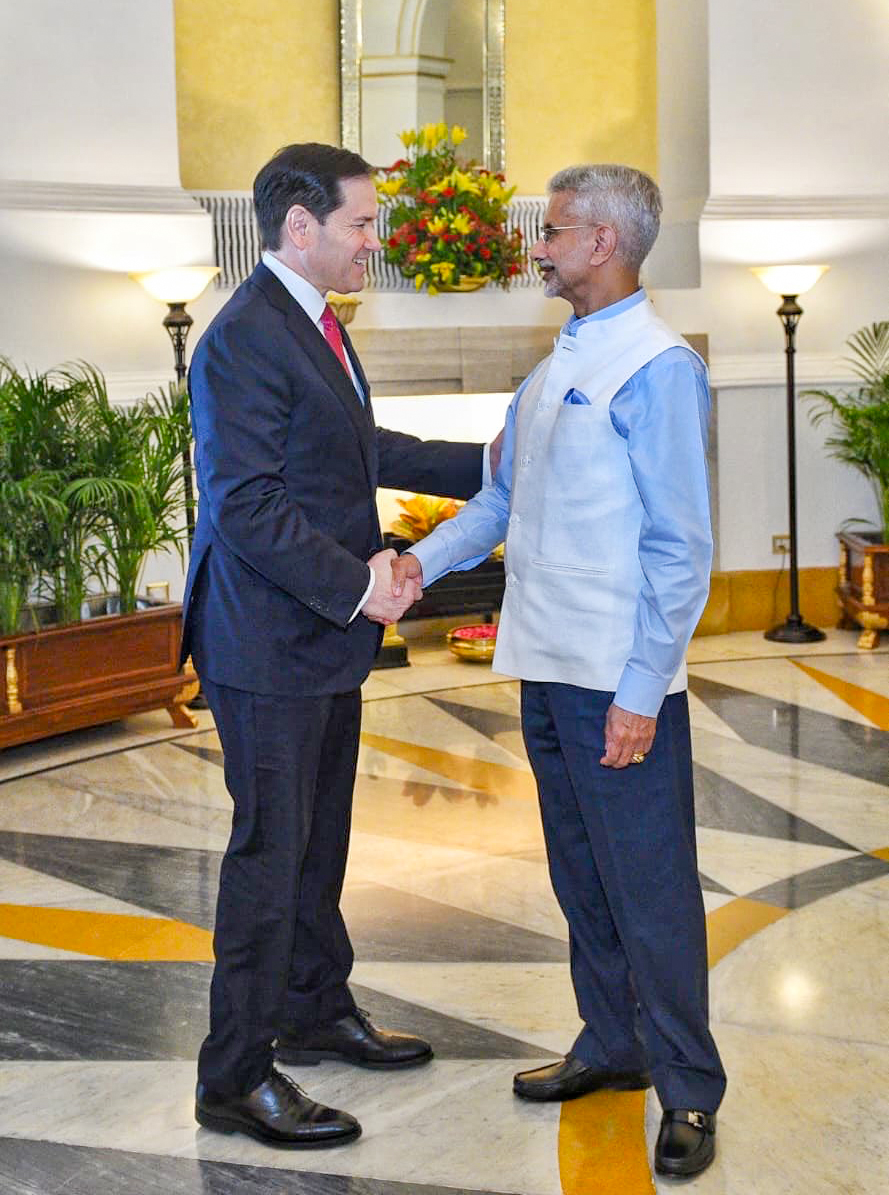
US Secretary of State Marco Rubio's visit to India is, at best, a mixed-picture story about the bilateral relationship between the US and India. For the past few years, what we have witnessed is a changed United States, especially from the time of the first Donald Trump administration, where its approach has been broadly transactional, irrespective of the proximity that the two countries have shared in the past.
This has meant that the renewed approach from Washington is indicative of a larger shift, which may not be specific to India, but indeed to the world at large. However, as these developments have coincided with India's growth story, with it being the fastest-growing large economy - the repercussions of these changes in the United States' approach impact India across sectors that are key both for growth as well as for the relationship itself, such as immigration, which undergirds the people-to-people ties and impacts the Indian diaspora in the United States, besides impacting thee Indo-Pacific balance of power where the United States appears to be ceding space deliberately.
With that backdrop, the Quad Foreign Ministers’ Summit in New Delhi, coinciding with Marco Rubio’s visit to India, gained far more importance for what it reveals about the test of the relationship and the changing nature and character of the bilateral relationship than for the deliverables themselves.
From what it appears, Rubio's visit to New Delhi kept the United States’ interests at the centre while keeping bilateral and minilateral concerns on the periphery.
Rubio’s visit to Kolkata as his first pit stop in a multi-city visit to India signalled — especially through the visit to the Missionaries of Charity - a Christian pivoting that appeals to both the domestic audience in the United States, which banks heavily on an evangelical base, as well as underscores the blatantly solipsistic attitude of the US, where it is ultimately out to look after its own interests.
The Missionaries of Charity had come under the scanner for its FCRA licence in 2021 by the Government of India, and therefore this visit subtly laid down the criticality of dropping key markers for the conservative vote bank in the United States ahead of the upcoming midterm elections later this year, while externally it is an assertion that draws the contours of faith in diplomacy and the importance of faith-based diplomacy for the United States under the Trump administration.
The other important mandate for Rubio’s visit seemed to be energy, which the United States does not appear shy of particularly emphasising the fact that India should buy more and more American energy in the backdrop of the crisis involving Iran. Energy requirements for any country, but particularly for India, which imports more than 40 per cent of its energy, are not something that can be shelved for later.
Over the years, the Trump administration crafted a strategy that banks on creating an energy matrix across the world while pivoting through the Middle East, catapulting the United States into one of the largest energy exporters in the world, leaving behind even Gulf partners and countries.
The Abraham Accords and the I2U2 were part of this larger exercise, which of course has been set back because of the crisis in the Middle East, which has raged on for years, as well as the crisis in Europe, where energy rerouting has taken place multiple times under pressure not to buy oil from Russia.
India, for itself, had to pay some of the highest tariffs in the world for buying Russian oil until a few months back, thanks largely to American pressure. As for Iranian energy, the United States forced several countries, including India, through sanctions, to reduce their energy dependence on Iran. In between this, the second Trump administration has, of course, laid out a plan which, regardless of the crisis, wishes to establish a supply chain that directly connects energy-hungry countries with Washington, which is now among the largest producers of energy in the world.
There is an inviolable link between Rubio’s shuttle diplomacy to India and the expansion of American oil exports to India. Pragmatically, for an energy-hungry country, it should not matter much from where its energy is sourced. But for a country that banks on strategic autonomy, the United States has particularly shown over the past year why India’s strategic autonomy vector should be further strengthened, if anything, even as India secures partnerships, new avenues, and engagements with other countries.
Finally, the Quad appears to be back on the table, which, from the perspective of regional balance of power, is timely. However, this is also happening in the backdrop of two important developments that undercut the potency of the Quad. First, the leaders’ summit of the Quad has still not happened and is long overdue, impacted largely by the United States’ scattered focus within its own western hemisphere.
Second, the Foreign Ministers’ Summit came in the backdrop of the US’ outreach to Beijing to strike a grand bargain -Í economic or strategic. There is some logic to the assumption that there is a larger strategic rationale for Donald Trump and that the competitive dynamic of the US-China relationship is going to continue regardless of how hard the administration tries to strike a bargain with China. But the optics of China’s diplomacy stand out, with multiple countries rushing to Beijing, most astoundingly with Donald Trump himself leaning heavily on Xi Jinping during his outreach.
The fact that the United States has moved a hard, pragmatic approach front and centre in its diplomacy with countries means India stands to be no exception. As such, from the Indian side, there should be a realistic assessment of what the Quad is and what it can achieve, even as India develops its own capabilities and diversifies its strategic and economic needs vigorously.
Originally published by ETV Bharat