
The G7 At Evian: Middle Powers, Burden-Sharing And The Rise Of The Rest
Originally Published by ETV
For a few years now, the G7 has functioned in tacit acknowledgement of the 'rise of the rest,' with a trend line depicting a favourable disposition towards a set of critical nations that are integrated with the Western economic system and are critical to global growth and governance.
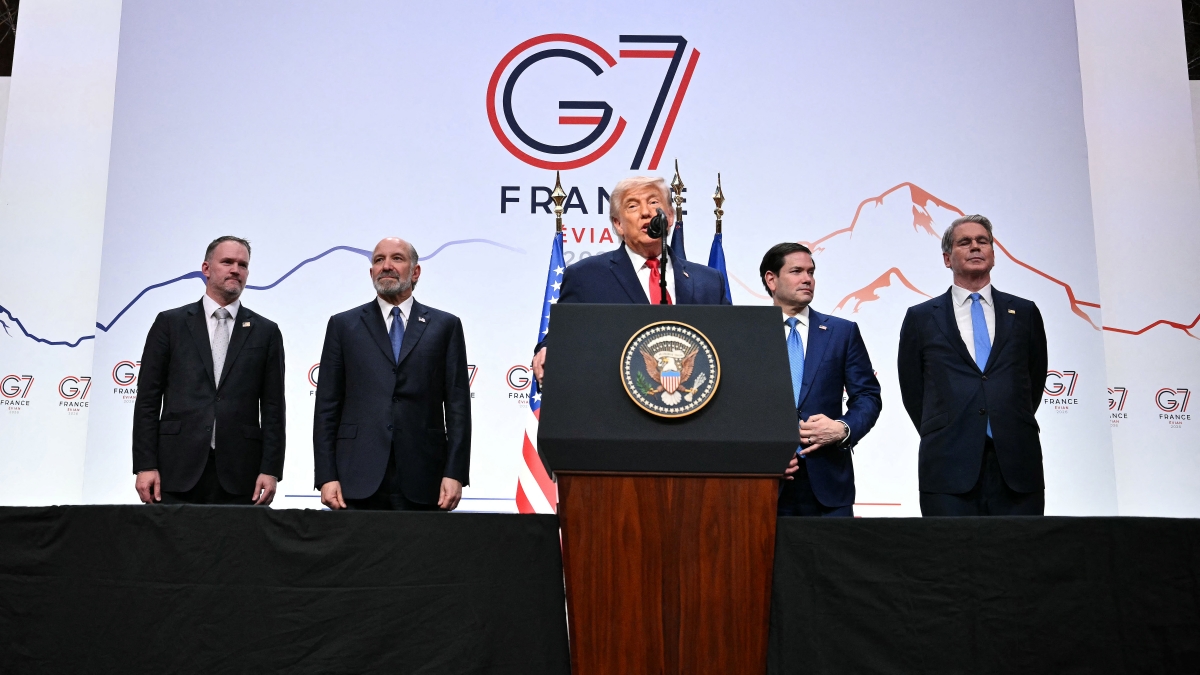
In the absence of both China and Russia, India loomed large as the largest economy among the 10 invited members besides the core G7 nations. Trump's presence at the meeting, without open hostilities against America's trans-Atlantic partners, was largely a result of Washington's preoccupation with the Iran ceasefire. With the ceasefire between Iran and Washington in the backdrop, the conversations around Ukraine received much higher attention.
The G7 leaders vouched for stronger support to Ukraine, even as the frequency and lethality of attacks between Russia and Ukraine have escalated.
The G7's support to Ukraine, especially from Europe, ascertained delivery of air defence capacities, additional systems and interceptors, and long-range capabilities, and that the members were now ready to consider extending to Ukraine the benefit of licenses to allow for an increase in Ukraine's military production.
The stronger European tone was partly because of the gradual but decisive shift in the second Trump administration's approach of enforcing larger burden-sharing by European partners as the new ground-rule of the trans-Atlantic alliance.
Trump's strategy of burden-shifting has carefully balanced between a push against Europe to buy defence equipment from the US and in turn supply it to Ukraine, rather than Washington extending support to Ukraine directly as an economic dole-out.
Further, in the backdrop of the US-Iran war and the crisis that had hit the global economy as a result of the closure of the Strait of Hormuz, Trump conditioned Washington's support to Ukraine on European countries' support in assisting through a global coalition that would have helped the US enforce the opening of the Strait—in other words, join the war against Iran.
The G7, in the backdrop of increasingly warring global scenarios, appeared to rely on its layered and systemic connections with countries outside the West. In this context, the positioning of Canada's Prime Minister Mark Carney stood out. Carney was at the helm in highlighting India's role, diplomatic capital and rising economic profile, placing it beyond a typical "middle power," as an essential voice for the Global South. The tone and tenor resonated with Carney's much-hailed speech at the World Economic Forum in January this year, when he launched a defence of 'middle powers,' even as great powers were combative, demanding and indeed dismissive of powers below them in the rung.
The announcement of the ceasefire between the US and Iran provided the European members with an opportunity to make amends with Trump, especially after they had been reluctant to join American efforts prior to the ceasefire, whether in opening the Strait of Hormuz or enforcing a collective blockade.
This was evident in the G7's commitments regarding a 'multinational, independent, and defensive initiative led by France and the UK can play an important role to facilitate the resumption of maritime traffic in the Strait of Hormuz by protecting merchant vessels, reassuring commercial shipping operators, and supporting verification that all mines are removed.'
The G7 meet in Evian was important for another commitment — on the Indo-Pacific. At a time when the US under the Trump presidency seems bent on a retrenchment of its commitments to the Indo-Pacific, the collective commitment on the Indo-Pacific region was reassuring for Asia, which has been reeling under the impact of the US-Iran war since February. China's absence from the G7 allowed for direct language on opposition to any unilateral attempts to change the status quo, in particular by force or coercion, in the East and South China Seas and across the Taiwan Strait. The irony of it all couldn't be masked, as the Trump administration has dithered on China, avoiding any mention of pressure points that could irk Beijing in what appears to be too hard a try from Washington to strike a grand bargain with China.
Leading up to the G7 meeting in Evian, China participated in the Global Convergence for Growth Summit convened by President Macron on June 11, but the lack of an organic integration of China into the group was balanced this time by Washington's self-inflicted distancing from its European partners. Resultantly, the spectrum for middle powers to contribute on issues of global growth and governance may have increased.
For India, the G7 reflects a consistency that is reflective of its economic growth and an expanding space on the global high table.
Three themes rightly resonated with New Delhi's global and domestic priorities, as enunciated in Evian. At a time when the Global North appears to be a laboratory, detached from the priorities of the Global South, India, as the largest Global South country, needs to put the right priorities on the table whenever an opportunity presents.
The rebuilding of trust was a call that suits India's unique position of not being in conflict with any of the warring parties and therefore an enabler of peace and stability, not just in its own backyard but indeed in the whole world. And finally, India's bet on connectivity is as timely as it is immediate. The security and political churn in global connectivity and supply chains as a result of the ongoing wars has mortgaged India's connectivity projects that banked on the Middle East as a tether. Perhaps, with the coming of an end to the Iran-US conflict, connectivity bets such as the I2U2 and the IMEEC will take off.